
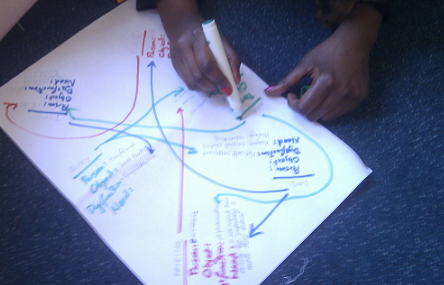
A new story concept takes shape in the first rehearsal of the Summer 2012 Studio Piece
The First Rehearsal
As any director will tell you, there is something special about the first rehearsal. It is the true beginning. It is the first time you can really start to visualise what the final production will look like. Your actors are meeting each other, perhaps for the first time and yet knowing that over the next couple of months they’ll go through an intense experience all together.
Having directed regular plays myself, I know at this time you sail slightly above it all. You know all the actors already. You have seen them audition and you have judged them the best fit to your vision of the play. You have a script in hand which you’ll have them read through and which will provide a focus and a structure throughout the entire development cycle. Everyone knows what they must learn; everyone has a measure by which they can judge process.
None of this is true for a Studio Piece. There is no script. You’re likely to have never met most of your actors before. And the only milestone you have is the brick wall of the first performance date. And it makes that first rehearsal all the more exciting.
We had our first rehearsal last Saturday. We have seven actors on board. A good number. Three of them I already knew (though I’d only seen one act before and that was several years ago) and four were completely new to me. It does cause a few difficulties right at the start as I tried to work out who, amongst all the people coming and going, were actually here for me, but it’s nevertheless a moment I savour. I have the rare privilege of meeting a person completely afresh, with no background and no preconceptions, and yet knowing that they will be a significant part of my life over the next seven weeks and that together we will create a story completely unique to our particular group of actors at this particular time in their lives. One actor more, one actor less, a different actor in the group, doing it a year from now, all of them would result in something different.
The first rehearsal was a crash-course in some improvisation basics. I use an exercise called Quick-Fire Questions to help stop improvisers from over-thinking and the Present Game to convey the idea of neutral ‘offers’ with defining acceptances. Both of these come from Keith Johnstone’s book ‘Impro: Improvisation and the Theatre’, one of the few books I’ve found genuinely helpful not just at suggesting games and exercises, but in describing how they develop the actors’ performances and how they connect into the skills we need to develop.
We then played with using defining acceptance to determine a character instead of an object. An actor left the room and the rest of the group decided what they were and acted appropriately to them when they re-entered. The focus actor then had to accept how they were being defined and react in that character. Almost like a reverse Party Quirks. We then focused on some simple, trying to get them as quick and straightforward as possible. Improvisers often instinctively draw out a scene in order to ‘make it more interesting’. They often achieve this by throwing more and more obstacles in the path of themselves or the other character who has a goal. Sometimes these can be good, but more often their highly tedious as we watch one actor trying to find yet another reason why he can’t simply buy an envelope from a post office. Interactions should (almost) always be extended, but this should be an active choice rather than a kneejerk reaction – and there should always be a definite purpose to it.
Finally, we went through the development process for this season…
The Process
As I said in my previous entry, the timeline of the Studio Piece is insane. The joy that the resulting play can be anything is matched by the terror that you’ll end up with nothing. When you start, it can be anything – but the more open the starting point, the more you need a definite process to carry you through. And, unlike most of our attempts at project management, the results of any deadline slippage are put on display for a paying audience.
This Piece has a new development process that’s been tested in the workshops I hosted over the last two seasons. I’ll talk more about it over the coming week, but the overall timeline remains the same:
Week One: Establishing the basics of successful improvisation. General exercises on character development, exploration of setting, getting to know each other.
Week Two: Improvised scenes between characters guided by the director in a variety of settings.
Week Three: Once a single setting is established, improvisation and discussion will then be used to establish basic character goals, arc and storyline.
By end of week three, we will have a ‘bare bones’ draft, inc. plot & scenes.
Week Four: Development of specific scenes through improvisation
By the beginning of week 5, we will have a complete draft of the play.
Weeks Five, Six & Seven: Standard rehearsal of script, only minor tweaks made.
I set this timeline four years ago and it’s stood the test of time pretty well. I wrote it originally out of necessity, working back from the performance date and wondering what was the absolute minimum time the actors would need to learn their lines. Putting myself in their shoes, I paled at the thought of learning a full part in two weeks and so I set it at three.
Then working back from that, I wondered how long we would need – assuming we had characters and a premise – to devise out what actually happened in the play. One week was too little and so I set it at two. This left the first two weeks to get to know each other, learn how to improvise and work well together, and then to actually play around with every single story concept you have time to squeeze in.
It’s a stretch, very true. You have to keep moving. No matter how promising an idea is, you can’t afford to explore it any longer than any other. If you do, you steal time from the period where it’s most desperately needed – where the actors need to learn their roles in order to put on a good show.
There is only one trick to it: that is to have enough confidence to always always always always move on when you hit that milestone. There’s plenty of time to look back, to second-guess, to regret, to wonder what might have been after the actors take their final bow. ‘Cos if you don’t, they’ll never make it that far.
Next time: The First Week