
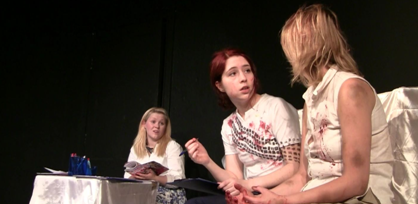
A scene from Ups & Downs, the Studio Piece in Summer 2009
I’m Richard and I’m the director of KDC’s devised Studio Piece this summer. The Studio Piece is a one-act play that’s devised and developed by the actors and director as part of the rehearsals. We start with nothing: no lines, no plot, no characters, no setting, no theme, and create it all as we go until we have a fully written script. The devisers then learn that script and perform it, just like a normal pre-scripted play. All within the rehearsal schedule of a regular KDC show.
If that sounds difficult, it certainly can be. To my mind, the KDC Studio Piece is one of the most challenging and exciting opportunities available in amateur theatre in London. It demands a commitment from every actor involved equivalent to taking on a substantial lead role and a spirit of cooperation and generosity between people who were strangers mere days before. But we’ve done it every year for the last three years and each time we have emerged with a successful production.
Over the next seven weeks we’ll be going inside the creation and development of the fourth Studio Piece, from the initial creative splurge, the cull of story concepts that will never be, developing and setting the surviving story into a script, and ultimately rehearsing the finished product.
But before we begin, this seems the right place for a quick look back at how the Studio Piece programme came to be…
The first Studio Piece was back in the summer of 09, but the spur for its creation came from three events the year before: I adapted and directed A Midsummer Night’s Dream, I joined the KDC committee, and I had a chance encounter at Newcomers with an old member.
Before MND, all the plays I had directed had been written by living (or still in-rights) authors. Rights agreements make the original play scripts pretty sacrosanct and so MND was my first chance to change the text I was given – and change it I did, from the classical setting to a modern day workplace of white collar workers, IT support staff and computer gremlins. The experience gave me some comfort in writing straight dialogue and, as I looked around at already-written plays, I realised that I was no longer interested in directing a show where I knew how the story would end before I even began. I wanted to be involved in something new, but I didn’t yet know what.
Joining the KDC committee involved me in the bad-end of the audition process for the first time. I’d auditioned for many shows before, even directed a few and so I knew the buzz of casting and being cast, as well as the disappointment of receiving the call from the assigned committee member telling me I’d not been successful that time around. What I never done before was to be on the other end of that phone call, being the committee member disappointing dozens of people in the space of few hours. While it is a bit more humane now, back then making the ‘no’ calls was a fairly soul-destroying assignment. It wasn’t so much the response of the actors you’re calling who are, almost invariably, polite about the whole thing; it’s reading their preference forms beforehand to get their phone number to make the call.
The preference forms give a small insight into the actor’s enthusiasm at the audition, and sometimes that keenness shines from the page. It is inevitable in any healthy theatre company that there are more auditionees than parts available. Without that excess of demand, directors could not choose who they felt best fit their vision of the play, resulting in a limp and mediocre production. It is a necessity, though an unfortunate one, that every season bright and talented actors, pipped at the post or without an appropriate part available, are left disappointed. These actors wanted parts, but we had no play to give them.
And then there was that chance encounter with an old member at Newcomers. Though not greatly active with us anymore, he’d been a member of KDC for twenty years and – as I was the closest thing KDC had to an archivist – I was grilling him for information on how the company used to be. He mentioned that, in the early nineties, there was something called the Studio Piece. Back then KDC had a small, but pretty consistent, membership and on occasion those acting members who hadn’t been cast in the main show created their own performance. I looked into the archive and discovered that there had been a couple of these, primarily sketch shows that easily support multiple creators.
The idea of doing the same, taking eager actors who hadn’t been cast or who weren’t interested in the main shows, and making a complete play stuck with me. It made sense. Given that you could never predict who would want to be involved, you simply couldn’t start with an existing play and try to fit actors into roles for which they might be entirely unsuited. The only way to do it properly was to start with the actors and then build the show around them. And if I was building a show around them, there’s no reason why they shouldn’t be equally involved in building it themselves. Once auditions for the main shows were done, I’d open up applications for the Studio Piece to get the actors in, then we would all create the show together, each actor creating their own character that suited them, weaving in their part of the overall story, then we’d rehearse it, then perform it alongside the main season.
The chain of thought was completely logical. The result it reached, however, was insane. Casting after the main shows, but then performing alongside them meant that – if they had eight weeks to rehearse a pre-written play – we would have to conceive of, write down and rehearse our own play in seven! Plus devising a play is not straightforward; there are false starts, there are wrong turns, you might generate a dozen different story ideas but you can only proceed with one. And, at the end of it all, could we convince a paying audience to come watch what we had created?
Next time: The Process