Summer Studio Piece: Pub Quiz Champion


KDC announces the summer devised piece
After weeks of devising, KDC are proud to announce the title of the new Studio Piece for this summer season. Two performances only on Sunday 15th and Sunday 22nd at 6:30pm at the Etcetera Theatre, Camden. See it for less if you’re watching another KDC show this season (details below). 

Pub Quiz Champion

Nothing much happens in the quiet town of Ansoforth. The height of excitement is the weekly pub quiz, billed as a good-natured, relaxed affair where taking part is more important than the win. 

That’s what it should be. But that’s exactly what it isn’t. 

As the answers go in, the knives come out. Dirty tricks, swiping team members, nobbling the barman, it’s all fair game as the quizzers’ game-lives and private-lives collide in the quest for the title of Pub Quiz Champion. 

Cast:

  • Fiona Thomas
  • Francis Whittaker
  • Ivo Dinkov
  • James Tully
  • Kim Morrison
  • Maeve McClenaghan
  • Vanessa Okello

Directed by Richard Williams
Assistant Director Trina Hasthorpe

Tickets £12 (£8 conc.) (Etcetera Theatre Club members £10.50/£6.50)

Two performances only, 6:30pm Sunday 15th July and Sunday 22nd July

Etcetera Theatre
265 Camden High Street
London NW1 7BU 

Important Booking information
Booking is open now on the Etcetera Theatre website listed as ‘Studio Piece’
Book online for 6:30pm, 15th July or 22nd July through Ticket Web

http://www.ticketweb.co.uk/user?query=search&region=xxx&category=misc&search=studio+piece&x=0&y=0# 

Or book for either performance over the phone on 020 7482 4857 

If you’re coming to see another show in the KDC summer season _before_ Pub Quiz Champion then you can get the Etcetera theatre member price (which is £1.50 less than regular ticket prices). When you come to see your first KDC show this summer season (or any Etcetera show in the last year) make sure you pick up your Etcetera Theatre Club membership card (the cost of the membership is included in a regular ticket price). Take that card along to the box office when you come to see Pub Quiz Champion and buy your ticket at club member rates. 

In short:
1) Buy a regular ticket for your first KDC show of the season
2) Get your Etcetera Theatre Club membership card when you come and see it
3) Book your ticket for your second KDC show over the phone
4) Pay the Etcetera Theatre Club membership ticket rates in cash at the box office.

Please note:
If you want to use the Etcetera Theatre membership discount, you must book over the phone rather than TicketWeb. The Box Office are not able to refund or reduce a TicketWeb ticket.

Phone bookings will require you to pay cash at the box office. There’s more information about phone bookings here: http://www.etceteratheatre.com/index.php?id=7

Studio Piece Summer 2012 – Dev Blog 3

 
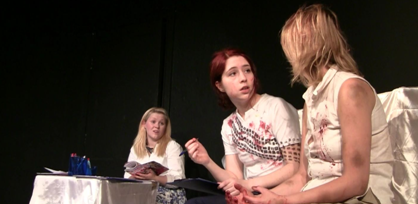
Natasha Wisdom as Sister Lucy and Matthew Slight as John in Ups & Downs, the Studio Piece
in Summer 2009

The First Week

Or part one of the ‘creative splurge’ as I described it so poetically in the first entry. As unattractive as it sounds, it’s a fair representation of what it’s like. Every rehearsal is different, the actors pour out new characters and storylines and then, as quickly as they’re established, they’re put aside and we move onto the next one.

Each cast member suggested a basic setting at the beginning of the week and every rehearsal since we’ve taken one of those one-line settings, developed it within the group, created characters, plot details and locations, thrown them out onto the stage and stood back to see what would happen.

Only one of the eight or so settings we’ll be exploring will be taken forwards, making this part of the process tremendously inefficient. But it’s also tremendously necessary and carefree. All we need to get from these two weeks is one idea with a germ of merit within it.

Much devised theatre starts with a concept or a theme or question in the director’s or writer’s head. They use the actors to help explore that notion and through that exploration a piece emerges. In previous years I have done the same – in a limited fashion – suggesting settings that might be interesting and appropriate for the age range or gender mix of the participants. This year, however, we’re starting with nothing that the cast aren’t bringing themselves and it is glorious fun.

In the first week we’ve created a dysfunctional family who’ve fallen from riches to rags due to a generation-old curse; we’ve adventured in a distant, surreal land of rebellion, twisted scenery, swamps, taverns and a movie studio; we’ve explored a story of alien and paranormal incidents that ended up as a cross between the X-Files and ALF; and we’ve convened an activist meeting of the militant Condiment Liberation Front who’ve brainstormed their plans to douse their targets in ketchup, mayonnaise and HP sauce to further their cause.

And there’s more to come in week two…


Creating Character

At the core of any story is character and so I thought I’d spend some time writing about how we go about creating our characters as part of the devised piece.

  • Inspiration comes from restriction.

There are people out there (I’ve met one of them) to whom you can say “Make up a character” or “Make up a story” and they can stand up and produce – off the cuff – a fresh and fully-formed concept or plot. The vast majority of us would blank, play for time, hem and haw, and either give up or haltingly produce something that, on reflection, we would realise was hopelessly derivative of the last book we read or film we saw.

Given the opportunity to create from ‘anything’, the vastness of the possibilities makes our imagination seize up. We need a focus, a hook, some spur to tell us what our character is (and thereby place restrictions on what it cannot be) to get our imagination working again. We don’t need it to give us the answer; we just need it to provide structure for our minds so we can find the answer for ourselves.

The focus can be almost anything. When I started with the devised piece, I used tarot cards. They fit my purpose quite nicely as their meaning is open to interpretation (there’s no right or wrong) they have a relatively clean visual image, normally with a human focus, and – especially with the Minor Arcana – there are small additional elements on them that the actor can choose to concentrate on or ignore. In our second year we moved onto using general works of art. The actors found some of the more abstract ones difficult at first. How can you create a character from a picture if you don’t understand what the picture is? The point is, though, not to correctly ‘interpret’ the picture, but rather to use whatever you get from the picture to inspire yourself.

Over the course of the last year I ran a series of workshops where one of the topics was the character creation process. The participants created characters using a variety of different methods: through random draw of predefined relationships, through random story fragments, through the inspiration of a picture and finally through the inspiration of a single word. The single word proved the most popular because they felt it gave them the most freedom to create their characters as opposed to trying to flesh out a character that they felt had already been created. We started this iteration of the devised piece using a single adjective as a focus, but found that even a single adjective provided too much of an answer. We found that starting off knowing that a character is ‘devious’ or ‘trusting’ left us trying to build a character around the adjective – so that everything about them was pointed towards that attribute. The adjective became a fixation rather than a focus to kick-start our own imagination, so now we’ve stepped back even further to use non-adjectives.

It may seem difficult at first, but for a deviser in the right mind-set even a mundane noun such as ‘chair’ or ‘carpet’ can trigger a series of creative sparks to allow them to start building a character. The less ‘obvious’ a word is at describing a character, the better it can be as a focus to allow your imagination to run riot.

  • Inspiration comes from trying to reconcile the irreconcilable.

The ever-present danger in quick creation is, as we reach for the character, we take grip of an archetype. And from that archetype we slip into cliché. When I first tried exploring a fantasy setting I had no less than five actors create a fairy-tale princess character (though it ended up entertaining enough with all five of them competing for the attentions of the lone dashing prince).

In truth, no character will stay cliché after the subsequent weeks of development, but even at an early stage we can move away from the obvious by adding a contrasting focus. When I used tarot cards, each actor drew two – and it was then their challenge to include aspects of both. When using a single word, the other members of the group ask the actor diverse questions about their character to provoke them to explore an aspect they wouldn’t have otherwise considered. The harder it is to reconcile the two sources of inspiration, the greater the imagination churns and the more surprising the result can be.


Next time: The Second Week

Studio Piece Summer 2012 – Dev Blog 2

 
A new story concept takes shape in the first rehearsal of the Summer 2012 Studio Piece

The First Rehearsal

As any director will tell you, there is something special about the first rehearsal. It is the true beginning. It is the first time you can really start to visualise what the final production will look like. Your actors are meeting each other, perhaps for the first time and yet knowing that over the next couple of months they’ll go through an intense experience all together.

Having directed regular plays myself, I know at this time you sail slightly above it all. You know all the actors already. You have seen them audition and you have judged them the best fit to your vision of the play. You have a script in hand which you’ll have them read through and which will provide a focus and a structure throughout the entire development cycle. Everyone knows what they must learn; everyone has a measure by which they can judge process.

None of this is true for a Studio Piece. There is no script. You’re likely to have never met most of your actors before. And the only milestone you have is the brick wall of the first performance date. And it makes that first rehearsal all the more exciting.

We had our first rehearsal last Saturday. We have seven actors on board. A good number. Three of them I already knew (though I’d only seen one act before and that was several years ago) and four were completely new to me. It does cause a few difficulties right at the start as I tried to work out who, amongst all the people coming and going, were actually here for me, but it’s nevertheless a moment I savour. I have the rare privilege of meeting a person completely afresh, with no background and no preconceptions, and yet knowing that they will be a significant part of my life over the next seven weeks and that together we will create a story completely unique to our particular group of actors at this particular time in their lives. One actor more, one actor less, a different actor in the group, doing it a year from now, all of them would result in something different.

The first rehearsal was a crash-course in some improvisation basics. I use an exercise called Quick-Fire Questions to help stop improvisers from over-thinking and the Present Game to convey the idea of neutral ‘offers’ with defining acceptances. Both of these come from Keith Johnstone’s book ‘Impro: Improvisation and the Theatre’, one of the few books I’ve found genuinely helpful not just at suggesting games and exercises, but in describing how they develop the actors’ performances and how they connect into the skills we need to develop.

We then played with using defining acceptance to determine a character instead of an object. An actor left the room and the rest of the group decided what they were and acted appropriately to them when they re-entered. The focus actor then had to accept how they were being defined and react in that character. Almost like a reverse Party Quirks. We then focused on some simple, trying to get them as quick and straightforward as possible. Improvisers often instinctively draw out a scene in order to ‘make it more interesting’. They often achieve this by throwing more and more obstacles in the path of themselves or the other character who has a goal. Sometimes these can be good, but more often their highly tedious as we watch one actor trying to find yet another reason why he can’t simply buy an envelope from a post office. Interactions should (almost) always be extended, but this should be an active choice rather than a kneejerk reaction – and there should always be a definite purpose to it.

Finally, we went through the development process for this season…


The Process

As I said in my previous entry, the timeline of the Studio Piece is insane. The joy that the resulting play can be anything is matched by the terror that you’ll end up with nothing. When you start, it can be anything – but the more open the starting point, the more you need a definite process to carry you through. And, unlike most of our attempts at project management, the results of any deadline slippage are put on display for a paying audience.

This Piece has a new development process that’s been tested in the workshops I hosted over the last two seasons. I’ll talk more about it over the coming week, but the overall timeline remains the same:

Week One: Establishing the basics of successful improvisation. General exercises on character development, exploration of setting, getting to know each other.

Week Two: Improvised scenes between characters guided by the director in a variety of settings.

Week Three: Once a single setting is established, improvisation and discussion will then be used to establish basic character goals, arc and storyline.

By end of week three, we will have a ‘bare bones’ draft, inc. plot & scenes.

Week Four: Development of specific scenes through improvisation

By the beginning of week 5, we will have a complete draft of the play.

Weeks Five, Six & Seven: Standard rehearsal of script, only minor tweaks made.

I set this timeline four years ago and it’s stood the test of time pretty well. I wrote it originally out of necessity, working back from the performance date and wondering what was the absolute minimum time the actors would need to learn their lines. Putting myself in their shoes, I paled at the thought of learning a full part in two weeks and so I set it at three.

Then working back from that, I wondered how long we would need – assuming we had characters and a premise – to devise out what actually happened in the play. One week was too little and so I set it at two. This left the first two weeks to get to know each other, learn how to improvise and work well together, and then to actually play around with every single story concept you have time to squeeze in.

It’s a stretch, very true. You have to keep moving. No matter how promising an idea is, you can’t afford to explore it any longer than any other. If you do, you steal time from the period where it’s most desperately needed – where the actors need to learn their roles in order to put on a good show.

There is only one trick to it: that is to have enough confidence to always always always always move on when you hit that milestone. There’s plenty of time to look back, to second-guess, to regret, to wonder what might have been after the actors take their final bow. ‘Cos if you don’t, they’ll never make it that far.


Next time: The First Week

Studio Piece Summer 2012 – Development Blog


A scene from Ups & Downs, the Studio Piece in Summer 2009

I’m Richard and I’m the director of KDC’s devised Studio Piece this summer. The Studio Piece is a one-act play that’s devised and developed by the actors and director as part of the rehearsals. We start with nothing: no lines, no plot, no characters, no setting, no theme, and create it all as we go until we have a fully written script. The devisers then learn that script and perform it, just like a normal pre-scripted play. All within the rehearsal schedule of a regular KDC show.

If that sounds difficult, it certainly can be. To my mind, the KDC Studio Piece is one of the most challenging and exciting opportunities available in amateur theatre in London. It demands a commitment from every actor involved equivalent to taking on a substantial lead role and a spirit of cooperation and generosity between people who were strangers mere days before. But we’ve done it every year for the last three years and each time we have emerged with a successful production.

Over the next seven weeks we’ll be going inside the creation and development of the fourth Studio Piece, from the initial creative splurge, the cull of story concepts that will never be, developing and setting the surviving story into a script, and ultimately rehearsing the finished product.

But before we begin, this seems the right place for a quick look back at how the Studio Piece programme came to be…

The first Studio Piece was back in the summer of 09, but the spur for its creation came from three events the year before: I adapted and directed A Midsummer Night’s Dream, I joined the KDC committee, and I had a chance encounter at Newcomers with an old member.

Before MND, all the plays I had directed had been written by living (or still in-rights) authors. Rights agreements make the original play scripts pretty sacrosanct and so MND was my first chance to change the text I was given – and change it I did, from the classical setting to a modern day workplace of white collar workers, IT support staff and computer gremlins. The experience gave me some comfort in writing straight dialogue and, as I looked around at already-written plays, I realised that I was no longer interested in directing a show where I knew how the story would end before I even began. I wanted to be involved in something new, but I didn’t yet know what.

Joining the KDC committee involved me in the bad-end of the audition process for the first time. I’d auditioned for many shows before, even directed a few and so I knew the buzz of casting and being cast, as well as the disappointment of receiving the call from the assigned committee member telling me I’d not been successful that time around. What I never done before was to be on the other end of that phone call, being the committee member disappointing dozens of people in the space of few hours. While it is a bit more humane now, back then making the ‘no’ calls was a fairly soul-destroying assignment. It wasn’t so much the response of the actors you’re calling who are, almost invariably, polite about the whole thing; it’s reading their preference forms beforehand to get their phone number to make the call.

The preference forms give a small insight into the actor’s enthusiasm at the audition, and sometimes that keenness shines from the page. It is inevitable in any healthy theatre company that there are more auditionees than parts available. Without that excess of demand, directors could not choose who they felt best fit their vision of the play, resulting in a limp and mediocre production. It is a necessity, though an unfortunate one, that every season bright and talented actors, pipped at the post or without an appropriate part available, are left disappointed. These actors wanted parts, but we had no play to give them.

And then there was that chance encounter with an old member at Newcomers. Though not greatly active with us anymore, he’d been a member of KDC for twenty years and – as I was the closest thing KDC had to an archivist – I was grilling him for information on how the company used to be. He mentioned that, in the early nineties, there was something called the Studio Piece. Back then KDC had a small, but pretty consistent, membership and on occasion those acting members who hadn’t been cast in the main show created their own performance. I looked into the archive and discovered that there had been a couple of these, primarily sketch shows that easily support multiple creators.

The idea of doing the same, taking eager actors who hadn’t been cast or who weren’t interested in the main shows, and making a complete play stuck with me. It made sense. Given that you could never predict who would want to be involved, you simply couldn’t start with an existing play and try to fit actors into roles for which they might be entirely unsuited. The only way to do it properly was to start with the actors and then build the show around them. And if I was building a show around them, there’s no reason why they shouldn’t be equally involved in building it themselves. Once auditions for the main shows were done, I’d open up applications for the Studio Piece to get the actors in, then we would all create the show together, each actor creating their own character that suited them, weaving in their part of the overall story, then we’d rehearse it, then perform it alongside the main season.

The chain of thought was completely logical. The result it reached, however, was insane. Casting after the main shows, but then performing alongside them meant that – if they had eight weeks to rehearse a pre-written play – we would have to conceive of, write down and rehearse our own play in seven! Plus devising a play is not straightforward; there are false starts, there are wrong turns, you might generate a dozen different story ideas but you can only proceed with one. And, at the end of it all, could we convince a paying audience to come watch what we had created?

Next time: The Process

Conference Call Cast List

Martin Mills – Jeremy Small
Doctor Rye – Alex Waddington
Doctor Walmer – Samantha Merrydew
Doctor Deal – March Fothergill

Assistant Director – Amy Jackson
Producer – Matthew Partridge
Video controller – David Balfour
Video maker – Nick Franco
Sound – David Crackles

Sister Mary Ignatius Cast List

Sister Mary – Fiona O’Sullivan
Diane – Anna Whitelock
Philomena – Catherine Ion
Gary – Kevin Morin
Aloysius – Oli Wilson
Thomas – Caleb Watson

Assistant Director – Helen Jackson
Producer – Peter Cabrera

Saturday Auditions! Sister Mary Ignatius Explains It All For You

Christopher Durang’s hilarious and dark comedy auditions on Saturday from 10am at the Saint Bride’s Institute. There are a further six roles on offer including the amazing Sister Mary Ignatius herself, an amazing opportunity and showcase for a female actor mid 40s+! If you’ve ever wanted to play a tyrant Nun, this is the hour!!!

Other roles detailed below.

Also, don’t worry if you missed out on this week’s auditions for A Number, F**kArt and Conference Call. The directors of those shows will be around from 12 pm if you would like to audition for them as well and did not have the chance this week! They are more than willing to see you!

Those Sister Mary roles in full then:
Sister Mary Ignatius – (mid 40s to mid 60s ish) intense and powerful presence, very sincere in her faith. Has no doubt.
Thomas – (7 years old) a current star student of the Sister. Parrots catechism with eerie innocence.
Gary Sullavan – ex student of the sister. Gay and practising Catholic, emotionally mature.
Diane Symonds – ex student of the sister. Serious, plain-spoken, distant and disaffected, disguising deep hurt. Has given up her faith.
Philomena Rostovich – ex student of the sister. Sweet, nervous, and shy. Vulnerable. Still Catholic.
Aloysius Busiccio – ex student of the sister. Blunt. Depressed alcoholic. Still Catholic.

Summer Season Auditions – Final Call!

Tonight is the final opportunity to audition for three of our four one-act plays which will be forming our Summer Season. Do come along from 6.30pm if you want the chance to get involved in this exciting project.

A Number, F**kArt and Conference Call:

6.30pm Wednesday 16 May, St Brides Institute, Bride Lane, Fleet Street, EC4Y 8EQ

Auditions for Sister Mary Ignatius Explains It All For You are this Saturday at 10am, again at St Brides.

A Number Characters

There are no stage directions and the script is very stylized. The younger actor will need to be able to play multiple roles. It is written as a play for two male actors but I would be interested to see female actors read for the younger role. For me this is a play about identity and what it means to be defined and the definite article.

Characters:

  • Bernard 1/Bernard 2 – Two different reflections of the same person, one scared and uncertain, the other threatening and angry (Male/Female, 20s-mid 30s)
  • Salter – Father of Bernard. Devoted to his son, but with a lot of shadows in his past and a selfish side in his nature. (Male, late 30s plus)

F**kArt Characters

Characters:

  • Simon/Frank:  two confident yet opposing characters played by one actor. Simon is the disapproving but clever agent, Frank is the wild, provocative, sex-obsessed artist (male, 20-30s).
  • Eric: Frank’s brother who poses as his agent; a shy, nervous man who is easily led by Simon and Frank (male, 20s).
  • Nadia: the Saatchi gallery buyer, a frustrated business woman who is desperate to be part of the artist’s world in any way (female, 20-30s)
  • Electra/prostitute: tasked with occupying the artist during the Saatchi visit and assisting with his artistic output, confident and unashamed (female, 20-30s)