F**kArt

F**kArt

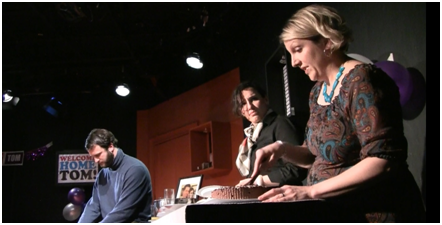
Sex sells and no one knows this better than Simon, cousin and silent partner in the business that is ‘Frank the artist’. Though Simon and Eric, Frank’s brother, may not approve of Frank’s questionable approach to production, Simon knows that “people like filth” and that the art world and the general public are always ready to buy into that.

F**kArt is a provocative, dark satire on the state of the art world. The play explores the relationship between art and sex and in doing so, questions the morality of the society we live in.


Summer Season Posters

Help us to publicise the summer season shows by downloading, printing and proudly displaying the posters:

A Number and F**kArt Poster

Conference Call and Sister Mary Ignatius Explains It All For You Poster

Pub Quiz Champion (The Devised Piece) Poster

Studio Piece Summer 2012 – Dev Blog 4

 
Arthur Zacharias as Anatole, Beril Kaya as Justine and Tracie Laurinaitis as Summer
in a scene from Last Order, the Studio Piece in Spring 2010

Guest blog – Trina Hasthorpe Assistant Director

Hi, I’m Trina. I’m the Assistant Director of the devised piece: the newly-announced Pub Quiz Champion.

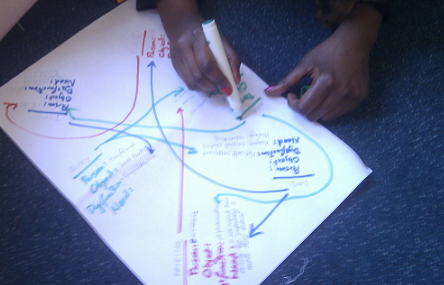
Staring at the web of multi-coloured scrawl on reams of A3 that are the fruits of our labour from the first devising session, I had my doubts. Reading through the character descriptions, setting notes, questions, answers, demands, and trying to follow the arrows that snake between them had me thinking – How could these disparate ideas generated by 7 strangers possibly evolve in a few short weeks to be a script – let alone a staged show?

At the halfway point now, with first draft in hand and a full run scheduled for our evening rehearsal, I am absolved of all doubt. In fact, my doubt dissipated weeks ago as I watched the actors, guided by Richard, bounce confidently and skilfully between a multitude of diverse and largely off-the-wall scenarios: bourgeois households to alien territories to lands of talking animals to the behind-the-scenes of a comedy club. I’ve seen reluctant farmers feed guerrilla armies, innocent husbands poisoned by spurned lovers, backroom witches tempt lonely priests and the elusive Danny Jones break more hearts than you can poke a stick at, but finally our story has found its home – in the more conventional yet highly entertaining setting of a local pub quiz.

The devising process that Richard has developed can be frustrating: having to let go of particular ideas about stories and characters is difficult at times, but the process relies on relinquishing control of the direction of the plot and dialogue decisions in order to give the actors free reign. And it pays dividends – the resulting script is funny without being affected, heartfelt without being cliché and honest without being boring. What was once scrawl is now a play – and a bloody good one at that.

Summer Studio Piece: Pub Quiz Champion


KDC announces the summer devised piece
After weeks of devising, KDC are proud to announce the title of the new Studio Piece for this summer season. Two performances only on Sunday 15th and Sunday 22nd at 6:30pm at the Etcetera Theatre, Camden. See it for less if you’re watching another KDC show this season (details below). 

Pub Quiz Champion

Nothing much happens in the quiet town of Ansoforth. The height of excitement is the weekly pub quiz, billed as a good-natured, relaxed affair where taking part is more important than the win. 

That’s what it should be. But that’s exactly what it isn’t. 

As the answers go in, the knives come out. Dirty tricks, swiping team members, nobbling the barman, it’s all fair game as the quizzers’ game-lives and private-lives collide in the quest for the title of Pub Quiz Champion. 

Cast:

  • Fiona Thomas
  • Francis Whittaker
  • Ivo Dinkov
  • James Tully
  • Kim Morrison
  • Maeve McClenaghan
  • Vanessa Okello

Directed by Richard Williams
Assistant Director Trina Hasthorpe

Tickets £12 (£8 conc.) (Etcetera Theatre Club members £10.50/£6.50)

Two performances only, 6:30pm Sunday 15th July and Sunday 22nd July

Etcetera Theatre
265 Camden High Street
London NW1 7BU 

Important Booking information
Booking is open now on the Etcetera Theatre website listed as ‘Studio Piece’
Book online for 6:30pm, 15th July or 22nd July through Ticket Web

http://www.ticketweb.co.uk/user?query=search&region=xxx&category=misc&search=studio+piece&x=0&y=0# 

Or book for either performance over the phone on 020 7482 4857 

If you’re coming to see another show in the KDC summer season _before_ Pub Quiz Champion then you can get the Etcetera theatre member price (which is £1.50 less than regular ticket prices). When you come to see your first KDC show this summer season (or any Etcetera show in the last year) make sure you pick up your Etcetera Theatre Club membership card (the cost of the membership is included in a regular ticket price). Take that card along to the box office when you come to see Pub Quiz Champion and buy your ticket at club member rates. 

In short:
1) Buy a regular ticket for your first KDC show of the season
2) Get your Etcetera Theatre Club membership card when you come and see it
3) Book your ticket for your second KDC show over the phone
4) Pay the Etcetera Theatre Club membership ticket rates in cash at the box office.

Please note:
If you want to use the Etcetera Theatre membership discount, you must book over the phone rather than TicketWeb. The Box Office are not able to refund or reduce a TicketWeb ticket.

Phone bookings will require you to pay cash at the box office. There’s more information about phone bookings here: http://www.etceteratheatre.com/index.php?id=7

Treasure Hunt and BBQ 7 July

Are you a fan of our beautiful city and want to explore it more?
Do you want a fun afternoon of crazy antics and silly games?
Do you want to find some of London’s best kept secrets?

Come to the BEST social yet….

* Team treasure hunt around London (pre-plan your teams or just come along and we’ll put you in a team)
* Prizes
* BBQ to finish the day
* Olympic themed games at the BBQ

Start and Finish at The Hoop & Grapes, Farringdon St, where Mike will be putting on a delicious BBQ.

Treasure Hunt meet at 1pm
BBQ from 4pm

Dracula – Cast List

Thank you to all those who auditioned and congratulations to the cast. Next KDC auditions will be after the summer for the to-be-announced winter season.

Dracula Cast and Crew

Director – Duncan Moore
Producer – Sally Wilks
Assistant Director – Steph Urquhart

Mina Westerman – Anna Marx
Lucy Westerman – Catherine Kolubayev
Florrie Hathersage – Kate Moore
Nurce Nisbett/Grice – Su Vigus
Jonathan Harker – Jimi Odell
Doctor Arthur Seward – William Baltyn
Count Vlad Dracula – Alan Maddrell
Van Helsing – Chris Stooke
Renfield – Marcus Mollan
Drinkwater – Mark Ewins

Studio Piece Summer 2012 – Dev Blog 3

 
Natasha Wisdom as Sister Lucy and Matthew Slight as John in Ups & Downs, the Studio Piece
in Summer 2009

The First Week

Or part one of the ‘creative splurge’ as I described it so poetically in the first entry. As unattractive as it sounds, it’s a fair representation of what it’s like. Every rehearsal is different, the actors pour out new characters and storylines and then, as quickly as they’re established, they’re put aside and we move onto the next one.

Each cast member suggested a basic setting at the beginning of the week and every rehearsal since we’ve taken one of those one-line settings, developed it within the group, created characters, plot details and locations, thrown them out onto the stage and stood back to see what would happen.

Only one of the eight or so settings we’ll be exploring will be taken forwards, making this part of the process tremendously inefficient. But it’s also tremendously necessary and carefree. All we need to get from these two weeks is one idea with a germ of merit within it.

Much devised theatre starts with a concept or a theme or question in the director’s or writer’s head. They use the actors to help explore that notion and through that exploration a piece emerges. In previous years I have done the same – in a limited fashion – suggesting settings that might be interesting and appropriate for the age range or gender mix of the participants. This year, however, we’re starting with nothing that the cast aren’t bringing themselves and it is glorious fun.

In the first week we’ve created a dysfunctional family who’ve fallen from riches to rags due to a generation-old curse; we’ve adventured in a distant, surreal land of rebellion, twisted scenery, swamps, taverns and a movie studio; we’ve explored a story of alien and paranormal incidents that ended up as a cross between the X-Files and ALF; and we’ve convened an activist meeting of the militant Condiment Liberation Front who’ve brainstormed their plans to douse their targets in ketchup, mayonnaise and HP sauce to further their cause.

And there’s more to come in week two…


Creating Character

At the core of any story is character and so I thought I’d spend some time writing about how we go about creating our characters as part of the devised piece.

  • Inspiration comes from restriction.

There are people out there (I’ve met one of them) to whom you can say “Make up a character” or “Make up a story” and they can stand up and produce – off the cuff – a fresh and fully-formed concept or plot. The vast majority of us would blank, play for time, hem and haw, and either give up or haltingly produce something that, on reflection, we would realise was hopelessly derivative of the last book we read or film we saw.

Given the opportunity to create from ‘anything’, the vastness of the possibilities makes our imagination seize up. We need a focus, a hook, some spur to tell us what our character is (and thereby place restrictions on what it cannot be) to get our imagination working again. We don’t need it to give us the answer; we just need it to provide structure for our minds so we can find the answer for ourselves.

The focus can be almost anything. When I started with the devised piece, I used tarot cards. They fit my purpose quite nicely as their meaning is open to interpretation (there’s no right or wrong) they have a relatively clean visual image, normally with a human focus, and – especially with the Minor Arcana – there are small additional elements on them that the actor can choose to concentrate on or ignore. In our second year we moved onto using general works of art. The actors found some of the more abstract ones difficult at first. How can you create a character from a picture if you don’t understand what the picture is? The point is, though, not to correctly ‘interpret’ the picture, but rather to use whatever you get from the picture to inspire yourself.

Over the course of the last year I ran a series of workshops where one of the topics was the character creation process. The participants created characters using a variety of different methods: through random draw of predefined relationships, through random story fragments, through the inspiration of a picture and finally through the inspiration of a single word. The single word proved the most popular because they felt it gave them the most freedom to create their characters as opposed to trying to flesh out a character that they felt had already been created. We started this iteration of the devised piece using a single adjective as a focus, but found that even a single adjective provided too much of an answer. We found that starting off knowing that a character is ‘devious’ or ‘trusting’ left us trying to build a character around the adjective – so that everything about them was pointed towards that attribute. The adjective became a fixation rather than a focus to kick-start our own imagination, so now we’ve stepped back even further to use non-adjectives.

It may seem difficult at first, but for a deviser in the right mind-set even a mundane noun such as ‘chair’ or ‘carpet’ can trigger a series of creative sparks to allow them to start building a character. The less ‘obvious’ a word is at describing a character, the better it can be as a focus to allow your imagination to run riot.

  • Inspiration comes from trying to reconcile the irreconcilable.

The ever-present danger in quick creation is, as we reach for the character, we take grip of an archetype. And from that archetype we slip into cliché. When I first tried exploring a fantasy setting I had no less than five actors create a fairy-tale princess character (though it ended up entertaining enough with all five of them competing for the attentions of the lone dashing prince).

In truth, no character will stay cliché after the subsequent weeks of development, but even at an early stage we can move away from the obvious by adding a contrasting focus. When I used tarot cards, each actor drew two – and it was then their challenge to include aspects of both. When using a single word, the other members of the group ask the actor diverse questions about their character to provoke them to explore an aspect they wouldn’t have otherwise considered. The harder it is to reconcile the two sources of inspiration, the greater the imagination churns and the more surprising the result can be.


Next time: The Second Week

Dracula Auditions – reminder

First round auditions for Dracula will be held on the 12th and 13th of June at the St Brides Foundation (details on our venues page). Please come along on whichever day suits you best and arrive at 6.30pm for a 7pm start. We’ll be finished by 9pm.

Recalls are by invitation only and will be held at the Hoop and Grapes. They’ll start at midday and will end around 4pm. You’ll be called in the week if the director would like to see you at the recalls.

Remember, auditions are free and you don’t need to bring a headshot or prepare anything in advance. Just come along and have fun!

Studio Piece Summer 2012 – Dev Blog 2

 
A new story concept takes shape in the first rehearsal of the Summer 2012 Studio Piece

The First Rehearsal

As any director will tell you, there is something special about the first rehearsal. It is the true beginning. It is the first time you can really start to visualise what the final production will look like. Your actors are meeting each other, perhaps for the first time and yet knowing that over the next couple of months they’ll go through an intense experience all together.

Having directed regular plays myself, I know at this time you sail slightly above it all. You know all the actors already. You have seen them audition and you have judged them the best fit to your vision of the play. You have a script in hand which you’ll have them read through and which will provide a focus and a structure throughout the entire development cycle. Everyone knows what they must learn; everyone has a measure by which they can judge process.

None of this is true for a Studio Piece. There is no script. You’re likely to have never met most of your actors before. And the only milestone you have is the brick wall of the first performance date. And it makes that first rehearsal all the more exciting.

We had our first rehearsal last Saturday. We have seven actors on board. A good number. Three of them I already knew (though I’d only seen one act before and that was several years ago) and four were completely new to me. It does cause a few difficulties right at the start as I tried to work out who, amongst all the people coming and going, were actually here for me, but it’s nevertheless a moment I savour. I have the rare privilege of meeting a person completely afresh, with no background and no preconceptions, and yet knowing that they will be a significant part of my life over the next seven weeks and that together we will create a story completely unique to our particular group of actors at this particular time in their lives. One actor more, one actor less, a different actor in the group, doing it a year from now, all of them would result in something different.

The first rehearsal was a crash-course in some improvisation basics. I use an exercise called Quick-Fire Questions to help stop improvisers from over-thinking and the Present Game to convey the idea of neutral ‘offers’ with defining acceptances. Both of these come from Keith Johnstone’s book ‘Impro: Improvisation and the Theatre’, one of the few books I’ve found genuinely helpful not just at suggesting games and exercises, but in describing how they develop the actors’ performances and how they connect into the skills we need to develop.

We then played with using defining acceptance to determine a character instead of an object. An actor left the room and the rest of the group decided what they were and acted appropriately to them when they re-entered. The focus actor then had to accept how they were being defined and react in that character. Almost like a reverse Party Quirks. We then focused on some simple, trying to get them as quick and straightforward as possible. Improvisers often instinctively draw out a scene in order to ‘make it more interesting’. They often achieve this by throwing more and more obstacles in the path of themselves or the other character who has a goal. Sometimes these can be good, but more often their highly tedious as we watch one actor trying to find yet another reason why he can’t simply buy an envelope from a post office. Interactions should (almost) always be extended, but this should be an active choice rather than a kneejerk reaction – and there should always be a definite purpose to it.

Finally, we went through the development process for this season…


The Process

As I said in my previous entry, the timeline of the Studio Piece is insane. The joy that the resulting play can be anything is matched by the terror that you’ll end up with nothing. When you start, it can be anything – but the more open the starting point, the more you need a definite process to carry you through. And, unlike most of our attempts at project management, the results of any deadline slippage are put on display for a paying audience.

This Piece has a new development process that’s been tested in the workshops I hosted over the last two seasons. I’ll talk more about it over the coming week, but the overall timeline remains the same:

Week One: Establishing the basics of successful improvisation. General exercises on character development, exploration of setting, getting to know each other.

Week Two: Improvised scenes between characters guided by the director in a variety of settings.

Week Three: Once a single setting is established, improvisation and discussion will then be used to establish basic character goals, arc and storyline.

By end of week three, we will have a ‘bare bones’ draft, inc. plot & scenes.

Week Four: Development of specific scenes through improvisation

By the beginning of week 5, we will have a complete draft of the play.

Weeks Five, Six & Seven: Standard rehearsal of script, only minor tweaks made.

I set this timeline four years ago and it’s stood the test of time pretty well. I wrote it originally out of necessity, working back from the performance date and wondering what was the absolute minimum time the actors would need to learn their lines. Putting myself in their shoes, I paled at the thought of learning a full part in two weeks and so I set it at three.

Then working back from that, I wondered how long we would need – assuming we had characters and a premise – to devise out what actually happened in the play. One week was too little and so I set it at two. This left the first two weeks to get to know each other, learn how to improvise and work well together, and then to actually play around with every single story concept you have time to squeeze in.

It’s a stretch, very true. You have to keep moving. No matter how promising an idea is, you can’t afford to explore it any longer than any other. If you do, you steal time from the period where it’s most desperately needed – where the actors need to learn their roles in order to put on a good show.

There is only one trick to it: that is to have enough confidence to always always always always move on when you hit that milestone. There’s plenty of time to look back, to second-guess, to regret, to wonder what might have been after the actors take their final bow. ‘Cos if you don’t, they’ll never make it that far.


Next time: The First Week